
2026 Deep Learning-based Rapid and Precise Die Design to Compensate Springback in Metallic Bipolar Plate Stamping for Proton Exchange Membrane Fuel Cells
본문
- Journal
- Measurement
- Date
- 2026-11
- Citation Index
- SCIE (IF: 6.1, Rank: 10.4%)
- Vol./ Page
- Vol. 290, pp. 122923
- Year
- 2026
Abstract
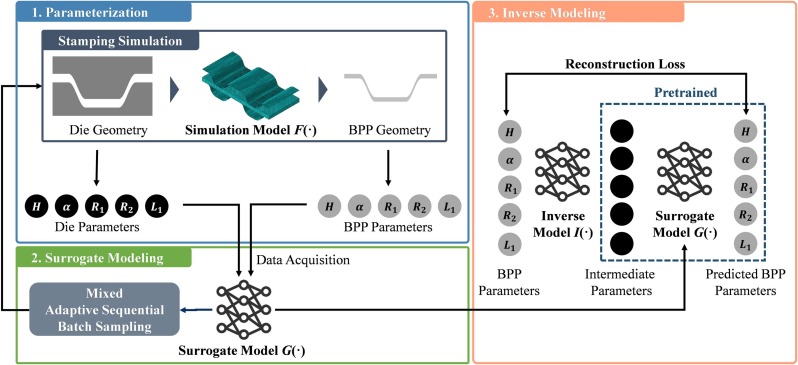
During the stamping process of metallic bipolar plates for proton exchange membrane fuel cells, springback leads to deviations between the intended and the final formed geometry. To minimize these deviations and achieve the desired bipolar plate geometry, studies have been conducted that focus on adjusting the die geometry; however, these methods often require extensive numerical or experimental iterations to achieve optimal results. Moreover, since this optimization process must be repeated for each new design variation, evaluating multiple design alternatives becomes highly time-consuming and computationally expensive. To address these challenges, a deep learning-based die design framework is proposed that efficiently predicts the optimal die shape while minimizing computational costs and enabling rapid evaluation of multiple design variations. First, the geometry of the die and bipolar plate are represented as simplified variables that a neural network can effectively learn. Next, a surrogate model is built using mixed adaptive sequential batch sampling to achieve accurate predictions while minimizing the number of required simulations. Finally, an inverse model is trained using a tandem neural network, enabling rapid prediction of the required die geometry necessary to achieve the target bipolar plate shape. The proposed approach was validated using a high-fidelity finite element model that closely resembles the actual stamping process. The results demonstrate that the proposed method can accurately determine the optimal die geometry required to produce the desired BPP geometry and significantly reduce computational effort across multiple design variations compared to conventional iterative methods.